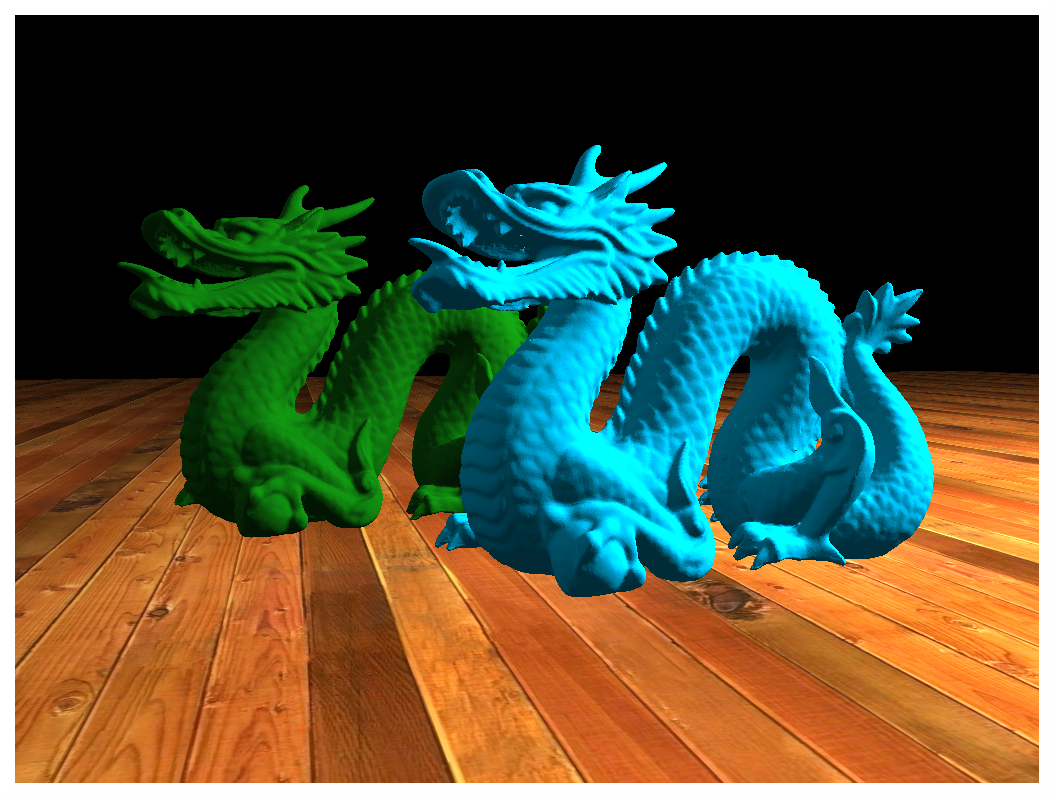
Stanford Dragon Diffuse Reflection
Created:
Sun 16 February 2020written by Xavier Figuera
Last modification:
Tue 10 February 2026The Stanford Dragon: Diffuse Reflection Rendering of a Classic 3D Model
The Stanford Dragon is a well-known 3D model originating from the Stanford 3D Scanning Repository, a project developed by Stanford University to provide high-quality reference models for computer graphics research and education. The model was created by scanning a small Chinese dragon statue using advanced 3D scanning techniques, capturing an exceptional level of geometric detail. Over the years, the Stanford Dragon has become a benchmark asset in the fields of rendering, shading, and geometry processing. Its complex surface, rich curvature, and intricate features make it especially suitable for testing lighting models and material behaviors.
This page presents a render of the Stanford Dragon composed of approximately 300,000 vertices, allowing for a detailed and accurate representation of the original scanned object. The rendering focuses on diffuse reflection, emphasizing how light interacts with the surface in a physically intuitive way. By relying primarily on diffuse shading, the form, volume, and fine surface details of the dragon are clearly revealed without the influence of strong specular highlights.
The result is a clean and informative visualization that highlights both the geometric complexity of the model and the fundamental principles of light–surface interaction. In addition, this render serves as a practical test case for evaluating the basic effects of the rendering engine, such as diffuse shading behavior, light distribution, and the overall response of the geometry under simple illumination conditions. This makes it especially useful for educational, technical, and experimental purposes in computer graphics.
Stanford dragon diffuse reflection